When Laughter Becomes a Mob
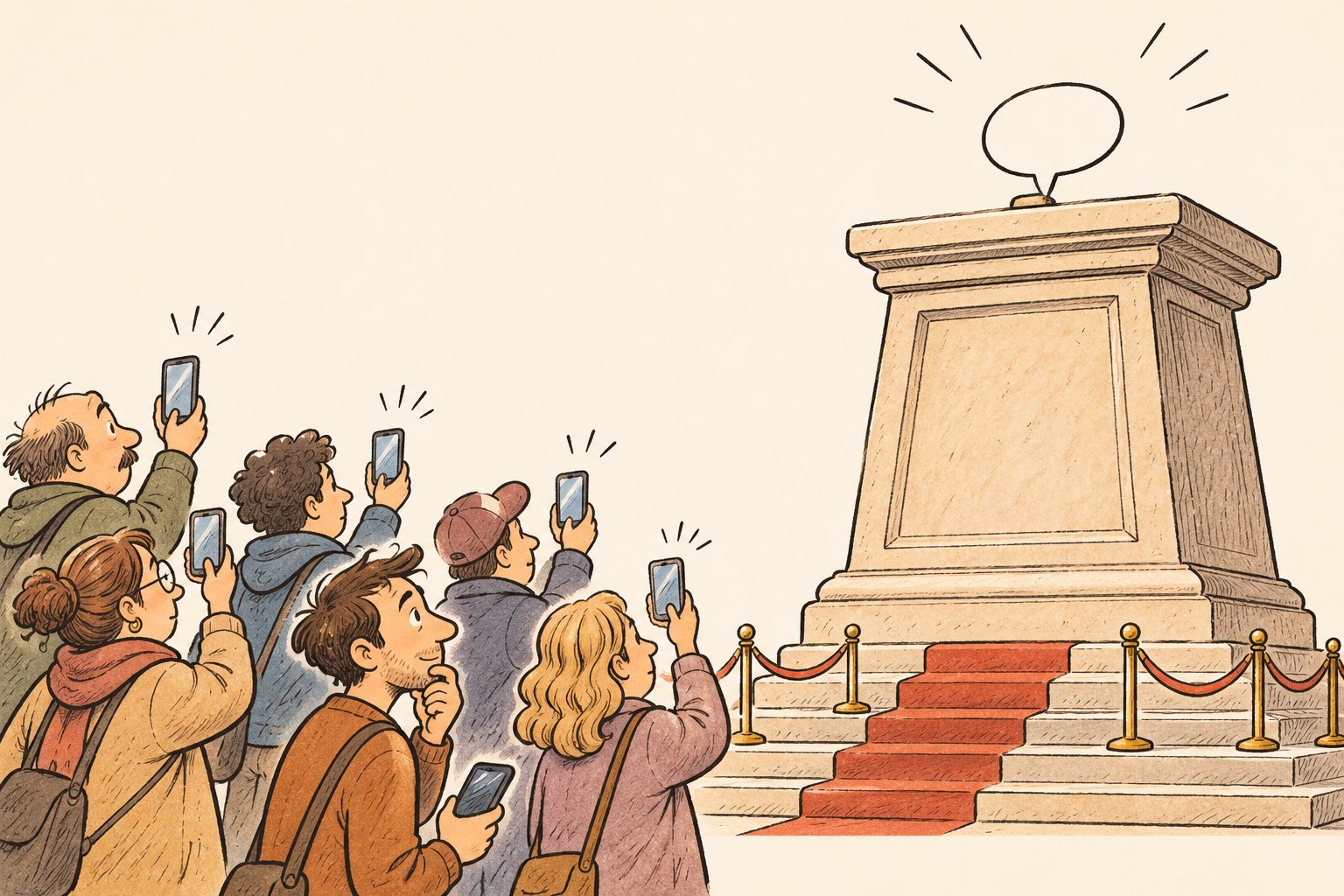
From Švejk and Bulgarian satire to the Coldplay video and the NVIDIA memes: on humour that exposes absurdity without stripping people of their dignity
Essay · 11 November 2026
By Anton Mitsev · Written with AI assistance
At a concert, a camera catches two people in an embrace. They see themselves on the giant screen and abruptly pull apart. The audience laughs. The singer makes a joke. Ten seconds that ought to vanish with the final notes of the song.
In July 2025, however, those ten seconds at a Coldplay concert did not stay inside the stadium. The footage went around the world. Strangers identified the people on screen; social media turned an awkward moment into a morality play, complete with villains. Both executives later left the technology company Astronomer. Months afterwards, Kristin Cabot described threats, public harassment and the effect on her children. She acknowledged that her conduct at the concert was inappropriate but challenged the prevailing account of a prolonged secret affair; she said both had already separated from their spouses. Her account deserves to be heard, but it is not, by itself, a definitive account of the relationship. [1][2]
The camera caught a gesture. The crowd decided it had seen an entire life.
In November 2026, another story handed the internet a seemingly irresistible plot. NVIDIA chief executive Jensen Huang admitted infidelity, and the company’s board announced an independent investigation into reports that he had been targeted by a foreign intelligence operation. News reports described an alleged relationship with a woman whom US intelligence officials reportedly suspected of ties to Chinese espionage. Huang’s admission and the espionage allegations are not equivalent facts: the allegations have not been publicly substantiated. NVIDIA said it had no reason at that point to believe that corporate secrets or US national security had been compromised. [3][4][5]
Whether the chief executive of a strategically important technology company has put its governance, intellectual property or compliance with export controls at risk is plainly a matter of public interest. It does not follow that the public is entitled to every intimate detail of the lives involved.
The internet has little patience for such distinctions. First comes the neat double meaning of model: NVIDIA makes the chips that power AI models, while the word also describes someone employed in fashion. Then come memes that place real faces in invented intimate scenes, including AI-generated parodies of the Coldplay footage. There is a further irony in using technology powered by graphics processors to fabricate convincing scenes about the man whose company supplies those processors. [6][7]
Some jokes are ingenious. Others turn another person’s life into a prop for public amusement. The point is not to divide laughter into what should be allowed and what should be forbidden. It is to distinguish humour that reveals something from humour that depends on somebody’s humiliation.
The person behind the punchline
Research on humour offers distinctions worth carrying beyond the academy. Psychologist Rod Martin and his colleagues describe affiliative humour, which helps bring people together, and aggressive humour, which makes others the butt of the joke. These describe uses of humour, not fixed traits of entire nations. [8]
According to benign violation theory, a broken expectation or social norm can be funny when the violation also feels harmless. [9] Yet in a viral spectacle, harmlessness depends on where you stand. For the viewer, a clip offers fifteen seconds of entertainment. For the person filmed, its consequences may endure for years.
Consider the familiar excuse: They’re public figures. They should be able to take it. Powerful people should expect close scrutiny of their public decisions. But scrutiny does not make their families fair game, or turn every private detail into a matter for public debate. Nor should a person become fair game simply because a viral clip has made them famous overnight. Accountability is not another word for humiliation.
How, then, do we laugh without losing sight of the person? Not by declaring one nation the world champion of kindness. The answer lies in artistic traditions that have mastered a harder art: dismantling the absurdity without dismantling the human being.
Five traditions of humane satire
This is not a sociological ranking of the world’s kindest nations. Czech, French, British, Argentine and German cultures all know both affectionate wit and merciless ridicule. These five examples are drawn from literature and the arts, not assessments of national character. They show how sharp satire can be without making the vulnerable its prey.
The Czech tradition: Švejk, or obedience as exposure
Jaroslav Hašek sends his Good Soldier into a military world that never doubts its own wisdom. Švejk obeys with such apparent zeal, and takes orders so literally, that the orders begin to sound absurd. At one point he recalls an officer’s maxim:
“A soldier must not think for himself. His superiors think for him.”
— Jaroslav Hašek, The Good Soldier Švejk, Book I, Chapter 8; an officer's words as reported by the protagonist. Translation for this essay. [10][18]
The words neither flatter authority nor belittle the ordinary soldier. The institution delivers its own indictment. Hašek’s comedy is anything but painless; war looms behind it. Yet whenever Švejk appears foolish, the machinery demanding his obedience looks more foolish still.
France: Jacques Tati, or the comedy all around us
In Mon Oncle, Monsieur Hulot wanders awkwardly through a world of spotless façades, ingenious machines and sterile modernity. Jacques Tati is not inviting us to laugh at a fool. He lets people and objects collide, revealing a society in which objects have grown more important than people. [11]
“Hulot is not the cause of funny situations. He is in the middle of them.”
— Jacques Tati, speaking to Penelope Gilliatt in The New Yorker, 1973. Original English wording as published. [19]
Two sentences, almost an entire philosophy of comic filmmaking. Hulot is not the flaw that needs exposing; he is the figure through whom the flaws in the world come into focus.
Britain: Yes Minister, or the polite scalpel
In the British television series Yes Minister, everyone is well-mannered, quick-witted and capable of producing an extraordinary amount of nonsense. Civil servants defend departmental interests in language that sounds uncannily like a defence of the public good. In one episode, a character remarks:
“The Official Secrets Act is not to protect secrets, but officials.”
— Antony Jay and Jonathan Lynn, Yes Minister, “Jobs for the Boys” (1980); dialogue from the programme. Original English wording. [12][20]
The scalpel cuts through institutional language. No one’s marriage or children need to be exposed for us to see who profits from secrecy. Nor does this mean British humour is humane by birthright: Britain also has a formidable tradition of merciless tabloid journalism. The achievement belongs to the writers, not to their nationality.
Argentina: Mafalda, or the disarming question
Quino’s young Mafalda asks grown-ups why a world they claim to govern rationally is full of war, inequality and hypocrisy. She needs no compromising photograph. An innocent demand for an explanation is enough. [13]
“Humour brings to light the absurd things we humans do.”
— Quino, interviewed by fellow cartoonist Tute; published in Infobae, 2020. Translated from Spanish for this essay. [21]
The crucial word is we. Not they—the fools who happened to get caught—but all of us, with our capacity for self-deception. Self-mockery need not soften a criticism. It can give that criticism moral weight.
Germany: Loriot, or the dignity of everyday absurdity
In Loriot’s sketch Herren im Bad (Gentlemen in the Bath), two grown men treat a bath and a rubber duck as matters of almost civilisational importance. The comedy springs from the solemnity with which we all sometimes defend our tiniest habits. [14]
“I show all-too-human things that really happen to everyone, things people can recognise in themselves.”
— Loriot (Vicco von Bülow), quoted in a retrospective published by Austria's ORF. Translated from German for this essay. [22]
That everyone makes all the difference. We are not looking down on a stranger’s weakness; we recognise our own. Sometimes the only difference between us and the ridiculous character is that the camera happens to be pointed elsewhere.
Bulgaria: a rich literary inheritance, a harsher public habit
It is tempting to say that the British know how to laugh gently, while Bulgarians prefer to sneer. It might pass as a remark over dinner; it would not pass as sociology. Such a claim would require comparable evidence across societies, and we have none. What we do have is a rich Bulgarian literary tradition that raises a more interesting question: why do we so often neglect the best of our own inheritance?
In Sako ot velur (The Suede Jacket), a play by Bulgarian dramatist Stanislav Stratiev, a bureaucratic error turns a man’s jacket into a sheep on paper. The state then behaves as though the sheep actually exists and demands its dues. When the man points out that the document contradicts reality, the following exchange ensues:
“Do you trust the document or the man?”
“The document. We deal in documents. You never know with people.”
— Stanislav Stratiev, Sako ot velur (The Suede Jacket); dialogue between Ivan Antonov and a civil servant. Translated from Bulgarian for this essay. [15][23]
Is the man ridiculous for trying to prove he owns no sheep? Hardly. The absurdity belongs to an institution that trusts a document more than the evidence before its eyes. The distance from this scene to an online verdict is painfully short: a screen offers a fragment, and the audience trusts it more than the complicated life beyond the frame.
Chudomir, the pen name of Bulgarian writer and artist Dimitar Chorbadzhiyski, understood vanity, gossip and petty malice intimately. His characters are no saints, and they can be cutting. Yet in the preface to his Selected Stories, he repeats an older comparison:
“They also say that if satire is the surgeon’s knife, humour is the ‘sweet balm’ for the wound.”
— Chudomir, preface to Selected Stories. He presents the comparison as an existing saying, not his own invention. Translated from Bulgarian for this essay. [24]
The important thing is not who coined the image, but that Chudomir chose it. After satire makes its incision, the wounded human being still has to live.
In the work of poet and satirist Radoy Ralin and illustrator Boris Dimovski, tenderness gives way to a fiercely political edge. Their Lyuti chushki (Hot Peppers), a collection of epigrams and drawings, fell foul of censorship precisely because it made power recognisable—and ridiculous. [16]
“Thorough Treatment”
“Come out in the right,
and you may not come out all right.”— Radoy Ralin, Lyuti chushki (Hot Peppers), epigram. A free English rendering intended to preserve the original’s parallelism and sting. [25]
There is nothing soft about this humour, nor should there be. It defends the individual against power, not power against embarrassment. That is the essential qualification to any idea of humane satire: it asks for no tenderness towards institutional violence, corruption or hypocrisy. It asks that the target be chosen with care.
Yet another habit persists in parts of Bulgaria’s public discourse: joking as a display of superiority. Someone has made a fool of themselves, so the crowd feels entitled to pile on. Someone looks uncomfortable, so discomfort itself becomes proof of guilt. This is a criticism of a visible public habit, not a scientific diagnosis of Bulgarian national character. Bulgaria neither invented the habit nor has to keep it.
That is the painful paradox. Bulgaria has given us outstanding literature about institutions that crush the individual. Yet on social media we sometimes become such an institution ourselves: no counter, no queue, just phones and a crowd.
When journalism joins the mob
In the NVIDIA case, the legitimate questions concern security, corporate governance and compliance with rules governing strategic technology. The Coldplay episode may likewise raise professional questions about executives’ conduct. Neither inquiry requires endless replays of embarrassed faces, speculation about families or AI reconstructions of intimate scenes.
Journalists can report events, test the evidence, examine consequences and demand accountability. What they must resist is importing the logic of viral entertainment wholesale into mainstream news, including national television bulletins. High audience ratings alone do not establish that a story serves the public interest.
The US Society of Professional Journalists’ Code of Ethics calls on journalists both to seek truth and to minimise harm. Information does not become ethically fit for publication merely because it is available. [17]
Nor are the rest of us innocent bystanders. Journalists and algorithms do not power the viral machine alone. Every casual share with the words You have to see this! adds fuel. Collective humiliation seldom has a single author. It has an audience that keeps extending its reach.
A joke that knows when to stop
A joke about NVIDIA need have gone no further than this imagined exchange:
“We’ve drafted a policy for working with outside models.”
“AI models?”
“That’s what Legal finally thought to ask yesterday.”
The joke keeps the double meaning, the corporate awkwardness and the technological context. It needs no photographs of partners, no children, no invented scenes from anyone’s private life. And it may still be funny long after the names have faded.
Satire need not be toothless. Sometimes the most humane thing it can do is bite power hard enough to hurt. But a line separates exposing wrongdoing from amplifying someone’s suffering. That line is not especially hard to see, if we are willing to look.
Perhaps a culture’s maturity is measured not by how far its jokes can go, but by whether it knows when to stop.
The best humour does not have to leave everyone smiling. It should leave us seeing more clearly. And still leave room for the human being.
References and source notes
Reporting and literary sources have been checked for this edition, dated 11 November 2026. Quotations from Tati and Yes Minister reproduce the published English wording; the remaining quotations are editorial translations from the source languages, with Ralin’s epigram rendered more freely to retain its verbal effect. The comparisons between humorous traditions, and the observations on Bulgarian public life, are critical interpretations rather than findings from a comparative sociological study.
- Reuters, 19 July 2025, “CEO of Astronomer resigns after viral kiss cam video.” Reporting on the incident, the response and the resignation. https://www.marketscreener.com/news/ceo-of-astronomer-resigns-after-viral-kiss-cam-video-ce7c5cdfda8ff220 ↩
- Los Angeles Times, 18 December 2025, “Woman from Coldplay kiss-cam incident says ‘wheels fell off the cart’ after hate-filled response.” Kristin Cabot’s later account, including her description of harassment. https://www.latimes.com/entertainment-arts/story/2025-12-18/coldplay-kiss-cam-woman-kristin-cabot-real-story ↩
- NVIDIA Newsroom, 8 November 2026, “A Message to Our Company.” Primary statement concerning Jensen Huang's admission. https://nvidianews.nvidia.com/news/a-message-to-our-company ↩
- NVIDIA Newsroom, 8 November 2026, “Statement From NVIDIA Board of Directors.” Primary statement on the investigation and the board's position. https://nvidianews.nvidia.com/news/statement-from-nvidia-board-of-directors ↩
- Associated Press, 9 November 2026, “Nvidia investigates whether CEO Jensen Huang was targeted by Chinese spy with whom he had an affair.” Reporting on the allegations and investigation. https://apnews.com/article/68839e7ca6ba2b121529f7e475e501d6 ↩
- Know Your Meme, 9–10 November 2026, “Nvidia CEO Jensen Huang Chinese Spy Cheating Controversy.” Used only to document the circulation of memes, not as evidence for the allegations. https://knowyourmeme.com/memes/events/nvidia-ceo-jensen-huang-chinese-spy-cheating-controversy ↩
- Fast Company, 10 November 2026, María José Gutiérrez Chávez, “Jensen Huang's affair with an alleged spy is powering a new class of realistic memes that Nvidia made possible.” On AI-generated parodies. https://www.fastcompany.com/91639444/jensen-huang-wife-and-alice-huang-featured-in-realistic-ai-memes ↩
- Martin, R. A., Puhlik-Doris, P., Larsen, G., Gray, J., & Weir, K., 2003, “Individual differences in uses of humor and their relation to psychological well-being: Development of the Humor Styles Questionnaire.” Journal of Research in Personality, 37(1), 48–75. https://doi.org/10.1016/S0092-6566(02)00534-2 ↩
- McGraw, A. P., & Warren, C., 2010, “Benign Violations: Making Immoral Behavior Funny.” Psychological Science, 21(8), 1141–1149. https://doi.org/10.1177/0956797610376073 ↩
- Jaroslav Hašek, The Good Soldier Švejk (Osudy dobrého vojáka Švejka za světové války, 1921–1923). Primary literary work. ↩
- British Film Institute, “A user's guide to the modern world... according to Jacques Tati.” Commentary on Tati's cinematic approach. https://www.bfi.org.uk/features/users-guide-modern-world-according-jacques-tati ↩
- BBC, Yes Minister, Series 1 (1980). https://bbc.originals.watch/media/51720/yes-minister/season/1 ↩
- Fundación Princesa de Asturias, 2014, biographical profile of Quino and Mafalda. https://www.fpa.es/en/princess-of-asturias-awards/laureates/2014-quino/?texto=trayectoria ↩
- Loriot official archive, “Herren im Bad (3-teilig)” (1978). https://www.loriot.de/index.php/loriot/werke/sketche/160-werk-sketch-herren-im-bad-3-teilig ↩
- Bulgarian Army Theatre, Sako ot velur, presentation of Stanislav Stratiev's play. https://www.tba.art.bg/%D1%81%D0%B0%D0%BA%D0%BE_%D0%BE%D1%82_%D0%B2%D0%B5%D0%BB%D1%83%D1%80___2523 ↩
- Biblioteka Bulgaria, “Neudobnite v balgarskata literatura” (The Unwelcome Figures in Bulgarian Literature). Context for Radoy Ralin and Lyuti chushki. https://www.biblioteka-bulgaria.bg/neudobnite-v-balgarskata-literat/ ↩
- Society of Professional Journalists, SPJ Code of Ethics, “Minimize Harm.” https://www.spj.org/spj-code-of-ethics/ ↩
- Jaroslav Hašek, Osudy dobrého vojáka Švejka za světové války, Book I, Chapter 8, “Švejk simulantem.” Czech text; the words are recounted by Švejk as his commander's. https://www.svejkmuseum.cz/new/roman/r_I_08.htm ↩
- Penelope Gilliatt, “Playing,” The New Yorker, 20 January 1973; interview with Jacques Tati. https://www.newyorker.com/magazine/1973/01/27/playing-2 ↩
- Antony Jay & Jonathan Lynn, Yes Minister, Series 1, Episode 7, “Jobs for the Boys” (1980). Published transcript of the original line. https://www.springfieldspringfield.co.uk/view_episode_scripts.php?episode=s01e07&tv-show=yes-minister-1980 ↩
- Infobae Cultura, 4 October 2020, “Quino a Tute, en una de sus últimas entrevistas...” Interview on the uses of humour. https://www.infobae.com/cultura/2020/10/04/quino-a-tute-en-una-de-sus-ultimas-entrevistas-el-humor-sirve-para-poner-en-evidencia-las-cosas-absurdas-que-hacemos-los-seres-humanos/ ↩
- ORF Ö1, 8 April 2017, “Loriot im Wortlaut,” a collection of Loriot’s remarks, including his comments on recognisable human experiences. https://oe1.orf.at/artikel/284398/Loriot-im-Wortlaut ↩
- Stanislav Stratiev, Sako ot velur (1976), excerpt of the play, published by Moyata biblioteka (Chitanka). https://chitanka.info/text/7439-sako-ot-velur-otkys ↩
- Chudomir, preface to Izbrani razkazi (Selected Stories), published by Moyata biblioteka. The surgical-knife/salve comparison is introduced as an existing saying. https://chitanka.info/book/268-izbrani-razkazi ↩
- Radoy Ralin, Lyuti chushki. Narodni epigrami (Hot Peppers: Folk Epigrams), “Kachestvena obrabotka” (Thorough Treatment), published by Moyata biblioteka. https://chitanka.info/text/44317-ljuti-chushki ↩
Translation and accuracy note: Hašek, Quino, Loriot, Stratiev and Chudomir are quoted in translations prepared for this article; Ralin’s epigram is a freer rendering to preserve the verbal contrast, not a published English translation. Tati and Yes Minister retain their published English wording. The lines from Hašek, Yes Minister and Stratiev belong to fictional characters, not to the authors speaking personally. NVIDIA’s own statements neither establish espionage nor name the woman involved. Cabot’s later account is attributed to her; the concert footage alone cannot establish the nature of the relationship.
Original editorial text and English adaptation: CC0 1.0 Universal. Third-party quotations and cited source materials are not covered by this dedication.